Skip to content
Graphify Labs · BooksFirst edition · 2026 ✳
A free book from the founder of Graphify

The Memory Layer.
Free to read.

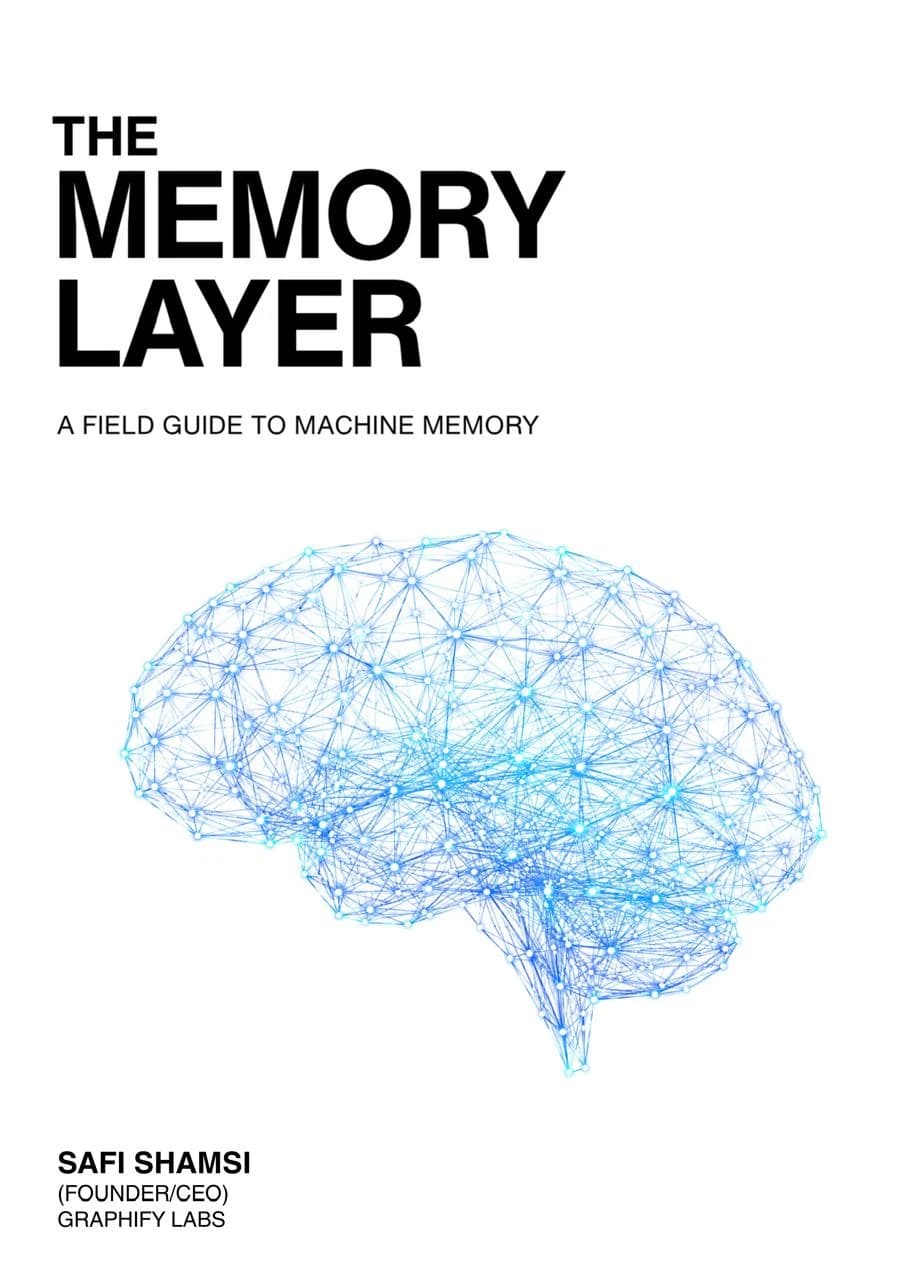
A field guide to machine memory, by Safi Shamsi.

From Aristotle's categories to Euler's bridges to the forty-eight hours that put Graphify on GitHub trending: why AI without memory is a goldfish with a spreadsheet, and what to build instead.

  • Knowledge graphs
  • Agent memory
  • Ontologies
  • Hypergraphs
  • Hallucinations
  • Graph databases

The download opens right here. No spam, unsubscribe any time.

  • PDF
  • 139 pages
  • 1.8 MB
  • $0
Read the opening

The book.
At a glance.

  • 139pages
  • 13chapters
  • 25centuries of the idea
  • 1command at the end
The argument

A goldfish with a spreadsheet.

You paste the same forty-two files into a chat. Again. The model answers perfectly, and has no memory that you ever asked. Bigger context windows only make the bowl bigger, and retrieval sorts the library by smell.

The book argues that intelligence, artificial or human, has always depended on the memory layer beneath it, and that the layer is a graph: a place for every fact, and a path between them.

QueryHow does authentication affect billing?

AVector similarity

  • Chunk AAuthService validates JWT tokens via middleware…0.82
  • Chunk BUserModel stores subscription tier and org_id…0.31
  • Chunk CBillingWorker generates invoices from subscription events…0.79

Two islands. The model guesses.

BGraph traversal

One path. The link in the middle is found.

From chapter one: the relationship lives in the white space between chunks.

Memory isn't a cache you refill every prompt.

Memory is a structure you inhabit.

Prologue · page 7
What is inside

Thirteen chapters, one argument.

It opens with a post and a goldfish, walks through graph theory, ontologies, hallucination and the modern memory stack, and ends with a pipeline you can build over a weekend.

Every chapter closes with what you now know. Open one to read it.

Pages
139
Chapters
13
Format
PDF
Get the free book
  1. 00Prologue: The 48-Hour Windowpage 7One short post from Andrej Karpathy, and a working tool on GitHub trending two days later.

    What you now know

    • One post shifted the industry from “retrieve chunks” to “traverse graphs.”
    • A knowledge graph is not a database trick; it is a structural memory layer that gives facts location and relationship.
    • Tools come and go, but the underlying idea, intelligence requires structured persistence, is ancient and unavoidable.
  2. 01The Goldfish Problempage 11Why every session starts from zero, and why bigger context windows only delay the forgetting.

    What you now know

    • LLMs are stateless goldfish: they compute brilliant answers inside a single forward pass, then forget you ever existed.
    • Scaling context windows or adding RAG retrieves more text, but it cannot traverse the relationships that live between chunks.
    • The bottleneck is not tokens or vectors. It is structure.
  3. 02An Ancient Ideapage 19Aristotle's categories were a data model, two millennia before Python.

    What you now know

    • Humans have thought in graphs for twenty-five centuries. Aristotle’s syllogisms, Porphyry’s tree, and Linnaeus’s taxonomy are all the same data structure with different names.
    • The Semantic Web gave us the triple. DBpedia and Freebase proved scale. Google proved utility. GraphRAG proved that graphs ground AI.
    • A knowledge graph is not a visualization. It is a memory architecture.
  4. 03What a Graph Actually Ispage 28Euler, seven bridges, and the language of nodes and edges.

    What you now know

    • A graph is nothing more than G = (V, E), vertices and edges, yet that simplicity is exactly why it scales from seven bridges to the entire web.
    • Real knowledge graphs are directed, weighted, and multi-relational.
    • Graphs have structure, including god nodes, clustering, and shortest paths, and that structure must be respected.
  5. 03bBeyond Binary: Why Simple Graphs Aren't Enoughpage 40When every edge looks the same, the map erases the difference between a motorway and a dirt track.

    What you now know

    • Binary graphs erase nuance: strength, type, direction, multiplicity, and shared context all vanish into a single pixel.
    • Real knowledge requires weighted, typed, directed hyperedges stamped with confidence so that both humans and agents know what to trust.
    • Graphify models memory as a rich fabric, not a connect-the-dots puzzle.
  6. 03cHypergraphs: When Relationships Have More Than Two Sidespage 47One event, many participants, and the fake nodes a binary graph forces on you.

    What you now know

    • Binary graphs force you to invent fake nodes for multi-way relationships; hyperedges let the relationship exist as itself.
    • A hypergraph replaces the adjacency matrix with an incidence matrix, and the math scales to any group size without changing form.
    • HGNNs aggregate by hyperedge groups rather than pairwise neighbors.
  7. 04Teaching Machines to Categorisepage 55Ontologies: the shared dictionary of what things are and how they relate.

    What you now know

    • RDF triples are the atomic unit of meaning; OWL adds inference; SKOS keeps it practical; JSON-LD gets it on the web; SPARQL queries it.
    • Real schemas like Schema.org, FHIR, and Wikidata power search engines, hospitals, and open knowledge, but they require armies of human experts to maintain.
    • LLMs can extract ontologies from raw text with explicit confidence tags, turning a months-long manual process into an auditable pipeline.
  8. 04bThe Hallucination Problem: How Graphs Keep AI Honestpage 64How a graph stops a model from citing a court case that never existed.

    What you now know

    • LLMs hallucinate because they optimize for plausible next tokens, not verified facts.
    • RAG reduces but does not eliminate hallucination; incomplete or ambiguous chunks still allow dangerous extrapolation.
    • Knowledge graphs replace porous text retrieval with discrete relationship traversal, and force every inferred claim to carry an auditable confidence score.
  9. 05The Modern Stackpage 73Four layers, each one fixing a failure that kills agents in production.

    What you now know

    • The four-layer stack: Storage, Intelligence, Orchestration, Construction. Skip one, and your agent collapses in production.
    • HybridRAG fuses vector similarity with graph structure. Neither alone is enough; the blend is the baseline.
    • Construction is where graphs live or die. Deterministic parsing and confidence tagging separate production systems from demos.
  10. 05bThe Graph Database Landscape: Choosing Your Storage Layerpage 81Picking where relationships live, once you accept they do not fit in rows.

    What you now know

    • Relational JOINs are workarounds for tabular storage; graph databases make relationships native.
    • Property graphs favor application development, while RDF favors formal data integration with semantic standards.
    • Your storage choice is a function of the wall you hit: speed, latency, data shape, infrastructure constraints. Not a feature checklist.
  11. 06The 48-Hour Toolpage 92The night Graphify was built, and the two years of work that made it possible.

    What you now know

    • Graphify compresses a five-million-token codebase into roughly one hundred seventy-six thousand tokens using nodes, edges, and community summaries.
    • The confidence firewall labels every edge as EXTRACTED, INFERRED, or AMBIGUOUS, so agents know which connections are steel and which are rope.
    • Graph-based BFS finds hidden architectural couplings in three hops that lexical search misses entirely.
  12. 07Build Your Own Memory Layerpage 101A weekend pipeline: raw text to a queryable graph to an MCP server.

    What you now know

    • How to extract structured nodes and edges from raw text using an LLM with a rigid JSON schema.
    • How to build, cluster, and name communities in-memory before committing to a graph database.
    • How to serve the graph over natural language and MCP so AI agents query it as a native tool.
  13. 07bNeurosymbolic AI: Teaching Machines to Reasonpage 111Neural networks and logic, and why an agent needs both.

    What you now know

    • Pure neural AI handles language and pattern recognition but hallucinates; pure symbolic AI reasons reliably but cannot scale to messy reality.
    • Neurosymbolic architectures combine both through three patterns: Neural→Symbolic, Symbolic→Neural, and Interleaved reasoning.
    • Knowledge graphs act as the symbolic memory layer, grounding LLM outputs in auditable structure.
  14. 08The Future of Machine Memorypage 120Vectors and graphs converge, and memory becomes the next frontier.

    What you now know

    • The future is HybridRAG: vector similarity and graph traversal fused via a tunable weight.
    • Agents are evolving from stateless chatbots into persistent systems that accumulate structured memory across sessions.
    • The industry is shifting from scaling parameters to scaling memory.
  15. ∞Epilogue: One Commandpage 129Run it on your oldest codebase and watch the god nodes light up.

    What you now know

    • A codebase is a knowledge graph in disguise.
    • The most connected nodes, god nodes, hold the system’s real weight.
    • Rendering the graph takes seconds. Understanding it changes everything.
  16. Plus references and further reading, organised by theme, from Euler (1736) onward.
Read the opening

The first two pages.

The prologue, as it is printed. The rest is one email away.

Prologue

The 48-Hour Window

Andrej Karpathy argued that AI should build persistent knowledge graphs instead of re-fetching RAG chunks every time.

It was a short post. No thread. No emoji. Just a grenade in a teacup.

For three years, the AI industry had duct-taped intelligence onto vector databases. The playbook was numbingly simple: chop your documents into chunks, squash them into floating-point vectors, and hope a cosine similarity search retrieves the right paragraph before the context window chokes. Chunk. Embed. Retrieve. Repeat.

Karpathy called the bluff. Memory isn't a cache you refill every prompt. Memory is a structure you inhabit.

7

8Prologue: The 48-Hour Window

But let's be ruthless. This is not a story about GitHub stars. Graphify will be forked, forgotten, and rebuilt seventeen times by Christmas. The tool is a symptom. The idea is the virus.

AI without memory is a goldfish with a spreadsheet. It computes. It does not know. And knowing requires something that a bag of vectors cannot provide: topology. A place for every fact. A path between them.

This book is not a tutorial. It is an argument.

The argument is that intelligence, artificial or human, has always depended on the memory layer beneath it.

8

Safi Shamsi

Founder & CEO, Graphify Labs

“The forty-eight hours were fast because two years were slow.”
Meet the team behind Graphify
About the author

Two years slow. Forty-eight hours fast.

Safi Shamsi is the creator of Graphify, an open-source knowledge graph engine that turns any folder of files into a queryable memory layer for AI agents.

He holds a thesis in knowledge graphs, examining how structured semantic representations accelerate reasoning in autonomous systems, and has published two research papers in the field.

The central question driving his work: not how to make models bigger, but how to give them memory that persists, connects, and compounds. The Memory Layer is his first book.

Reading papers on ontologies late at night, rebuilding extraction pipelines, dead ends in semantic reasoning. Then one night at 11 PM.
Free download · PDF · 1.8 MB

Get The Memory Layer.

All 139 pages, free. Leave your email and the download opens on this page.

The download opens right here. We will only write about the book and Graphify, and you can unsubscribe any time.

Questions

Frequently asked.

Who is The Memory Layer for?

Engineers who keep re-explaining their system to an AI assistant, leaders choosing an AI stack, and anyone curious how machines remember. It starts from first principles and builds to a working memory layer.

Is it really free?

Yes. Enter your email and the full 139-page PDF downloads right on this page. There is no payment and no trial.

What does the book cover?

Thirteen chapters on why stateless models forget, graph theory from Euler onward, weighted and hyper graphs, ontologies, hallucination, the modern memory stack, graph databases, the 48-hour build of Graphify, building your own memory layer, neurosymbolic AI, and where machine memory goes next.

How is it different from the Graphify docs?

The book is the argument and the ideas underneath: why memory has to be a graph, and how that graph is built. The docs at docs.graphify.com cover installing and running Graphify itself.

Do I need to write code to follow it?

No. The technical chapters include code, and the build chapter carries a plain-language walkthrough beside it, so the argument reads end to end without a terminal.

Try Graphify now.

Try for free