

CodeRabbit alternatives for AI code review
11 minute read

The best CodeRabbit alternatives for AI code review are the tools that change what the reviewer can see, not just how many comments it leaves. Graphify is the alternative we would start with: it reviews a pull request against a code graph of the repository, so a finding can name callers and dependents the diff does not show, and the same graph is there for your coding agents. This post compares Graphify with CodeRabbit, Qodo, Greptile and Kodus. We make Graphify. Every claim about another product links to that product's own docs, read on 26 November 2026.
A shorter, broader list of reviewers, including Copilot, Codex, Cursor Bugbot and Claude Code, is in our AI code review tools post. This one is the CodeRabbit alternatives page: a fair look at the tools people actually reach for when they type that query.
What does CodeRabbit do well?
CodeRabbit is an AI reviewer built around the pull request. After you connect a repository, it analyzes new pull requests and later commits, then posts a review with a summary, inline comments, severity labels and suggested fixes you can apply in one click. Its FAQ, read on 26 November 2026, is explicit: CodeRabbit does not only review the diff. If a pull request changes a function, it can inspect a caller in another file outside the diff.
It also runs more than 50 open source linters and security scanners and passes those findings into the review, and it documents code graph analysis of relationships in the project. You can trigger a review yourself with @coderabbitai review or @coderabbitai full review. Plugins exist for VS Code, Cursor, Windsurf and JetBrains (the JetBrains plugin is in beta). Official setup guides cover GitHub, GitLab, Bitbucket and Azure DevOps.
If your team already lives in that pull request thread, CodeRabbit is a complete reviewer, not a placeholder in this list.
Why do teams look at CodeRabbit alternatives?
The complaint that comes up most often is comment volume. A review that catches real bugs still loses trust if most of the thread is nits, because people start skimming and then miss the finding that mattered. CodeRabbit documents review profiles and other ways to reduce noise, and some teams say that helps once they tune it. Others still find the comments too chatty, even after they try.
On 21 November 2025, Alperen Keleş (@Keleesssss) wrote:
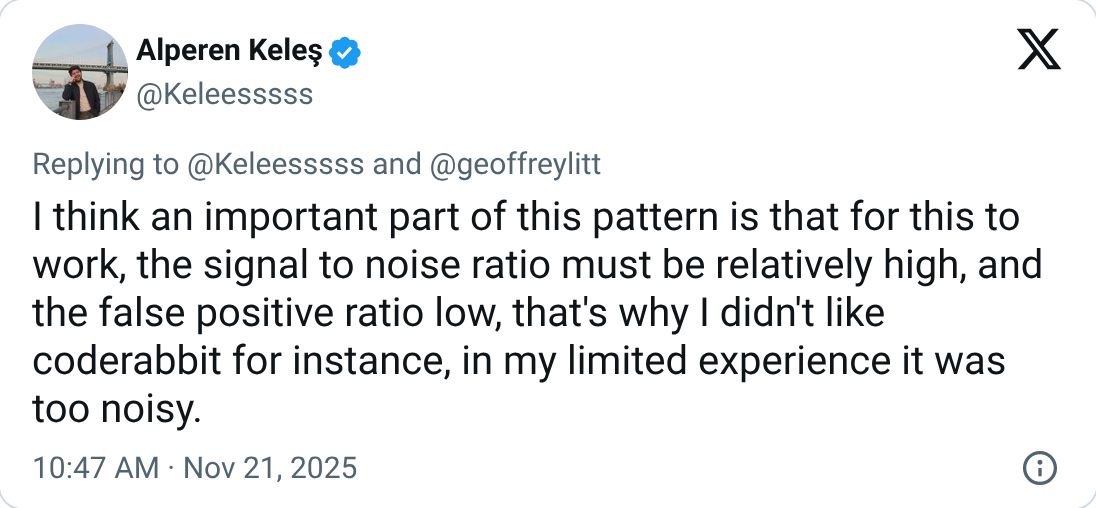
I think an important part of this pattern is that for this to work, the signal to noise ratio must be relatively high, and the false positive ratio low, that's why I didn't like coderabbit for instance, in my limited experience it was too noisy.
Batuhan Icoz (@batuhan) was more mixed, after enabling it for the Beeper org, on 6 May 2025:
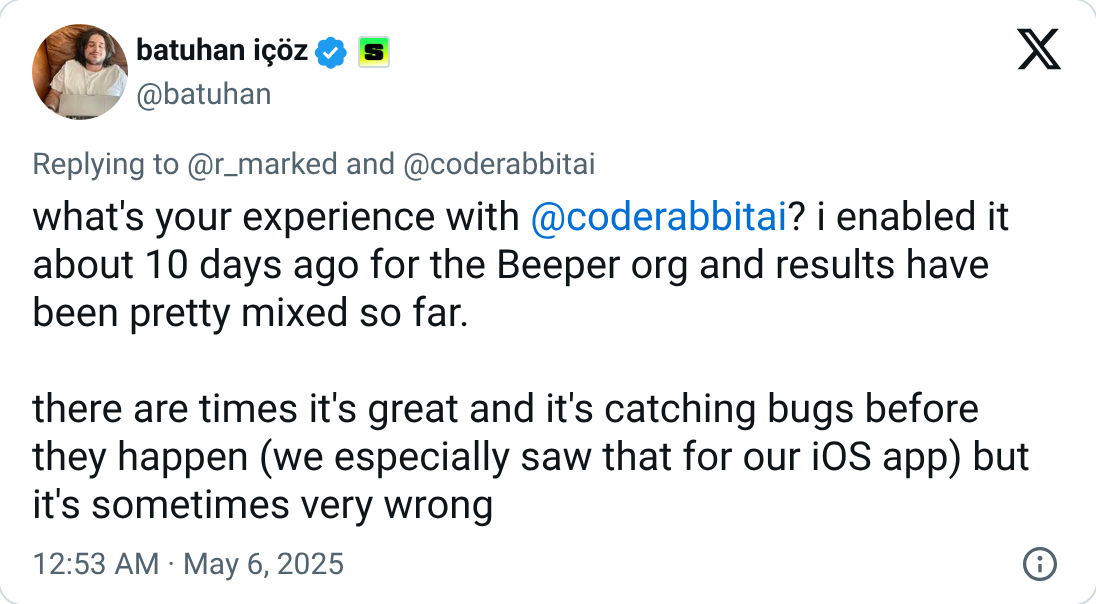
what's your experience with @coderabbitai? i enabled it about 10 days ago for the Beeper org and results have been pretty mixed so far.
there are times it's great and it's catching bugs before they happen (we especially saw that for our iOS app) but it's sometimes very wrong
The same theme shows up in longer threads. In August 2026, u/NextSubject227 wrote on Reddit:
on bigger PRs especially, you can end up with a wall of review comments where a few are genuinely useful but a lot are things i'd never block a PR over.
and at some point that makes the good comments less useful too. if engineers get used to dismissing half the bot's comments, they're eventually going to skim the one that actually matters.
In September 2025, Nic Cope set CodeRabbit to chill mode in Crossplane after a test pull request under the assertive profile:
On my test PR https://github.com/crossplane/crossplane/pull/6777 the assertive mode was approaching 200 comments. Admittedly not all from CodeRabbit, but generally too noisy.
That is a fair reason to look at alternatives. It is not a reason to pretend CodeRabbit never catches bugs. The question is whether the comments you keep reading are the ones that change the review.
CodeRabbit alternatives at a glance
| Tool | What the review can see | Where it runs | Local option |
|---|---|---|---|
| Graphify | The pull request, read against a code graph of callers, dependents and tests. When repositories are combined, the review also lists impact in the other repositories. | Comments on GitHub and GitLab pull requests. Agents can read review status over MCP. | The Graphify CLI builds the graph on your machine, with no account. |
| CodeRabbit | The pull request plus relevant context from the repository, including callers outside the diff, plus linter and scanner findings. You can also link related repositories. | Pull request comments, plus IDE and CLI review. GitHub, GitLab, Bitbucket and Azure DevOps. | IDE and CLI review in the CodeRabbit product. There is no open source engine on its docs. |
| Qodo | The full repository, not only the diff, with specialized review agents and an optional Merge Risk assessment. Cross-repository code review is in Beta. | Pull request comments, plus a local qodo review command. | The Agentic Toolbox Reviewer skill is in Beta. The base commit still needs to be reachable by Qodo's review engine. |
| Greptile | The pull request plus a graph Greptile builds of the repository, as we described in the AI code review tools comparison. | Pull request comments. | Not claimed as a fully local, no-account reviewer in the pages this post relies on. |
| Kodus | The pull request, checked against your team's rules, with a model you provide. | Pull request comments on GitHub, GitLab, Bitbucket, Azure Repos and Forgejo. | Kodus is open source and can run on your own infrastructure. |
Graphify as a CodeRabbit alternative
Graphify is shared codebase context: a code graph, a Wiki, Memory and PR reviews. The review is the part that substitutes for a pull request bot like CodeRabbit. The graph is the part that also helps while the code is being written.
Graphify reviews a pull request when it is opened, reopened or marked ready for review. A draft is skipped until it is marked ready. A later push does not start another review. After new commits, a repository owner, member or collaborator comments @graphify review. Each run analyzes the full pull request, from where it branched to its latest commit, and reads the change against the indexed default branch. Feedback on a finding is @graphify wrong, @graphify good or @graphify suppress.
The review comment includes a merge confidence score from 1 to 5, based only on findings the review could confirm against the code or a test. If the repository is part of a combined graph, the comment also adds a Cross-repo impact section that lists callers and dependents in the other repositories. That section is advisory. It does not change whether the Graphify check passes or fails.
On Graphify's code review benchmark, CodeRabbit's publicly available result on the same 50 pull requests is 22 of 50, or 44%. That figure uses the original grading from July 2025. The comparison scored with Graphify's rule is Graphify at 71% of real bugs, against 56% for the top published reviewer. The 71% figure is the mean of three independent runs in November 2026 on 50 real bug-introducing pull requests from five production codebases. Every catch and miss is hand-verified. Results vary by codebase.
Prefer to stay local? Run uv tool install graphifyy. The Graphify CLI builds the graph on your own disk, with no account, and graphify prs can list open pull requests and the graph communities they share, including overlaps with graphify prs --conflicts. For a checklist that is not tied to any vendor, see how to review an agent-written PR.
Other CodeRabbit alternatives
Qodo. Qodo's code review uses specialized agents for correctness, standards, architecture and risk, then a judge agent merges the findings before they reach the pull request. Qodo says it analyzes the full repository, not just the changed lines. The Agentic Toolbox adds a local qodo review command so an agent can review uncommitted work before a pull request exists. That skill is in Beta, and Qodo's docs say only the base commit needs to be pushed because the review engine clones it from your Git provider.
Greptile. Greptile is an AI reviewer that builds a graph of the repository and comments on the pull request. We compared it, without prices, in the AI code review tools post, and in Greptile alternatives. If you are already on Greptile and thinking about moving, migrating from Greptile is the guide. This post does not repeat that guide.
Kodus. Kodus is an open source pull request reviewer you can run on your own infrastructure. Kody can review a pull request when it opens, and you can start a review with @kody start-review. You connect your own model. Official docs cover GitHub, GitLab, Bitbucket, Azure Repos and Forgejo. If the job is a self hosted reviewer you operate yourself, Kodus may fit that job more directly than Graphify's hosted reviews.
When CodeRabbit may fit better
CodeRabbit may fit better when you want automatic incremental reviews on later pushes, a structured walkthrough on the pull request, one click suggested fixes, dozens of bundled linters and scanners, review from an IDE plugin, or repositories on Azure DevOps or Bitbucket. Graphify reviews GitHub and GitLab pull requests, and it does not start a new review on every push unless someone comments @graphify review.
CodeRabbit may also fit better when the team already chats with @coderabbitai in the thread and does not want to change that habit. In that case Graphify can still sit beside it as shared codebase context, rather than as a replacement you have to switch to overnight.
When Graphify may fit better
Graphify may fit better when the misses you care about live outside the hunk: a caller in another package, a test that no longer reaches the changed function, or a path the diff does not show. It is also the option to reach for when several agents and people should share one graph of the same repositories, rather than each reviewer discovering the structure again. The graph based review explainer and change impact analysis post go deeper on that job.
If you want the graph and the impact queries on your own machine, with no account, the Graphify CLI is the local CodeRabbit alternative in this list.
Try it
Connect a repository at app.graphify.com, open a pull request, and read the Graphify review. After a push, comment @graphify review for a fresh run. If you disagree with a finding, reply @graphify wrong.
Prefer to stay local? Run uv tool install graphifyy for the open source Graphify CLI, which is licensed under Apache 2.0. Related reading: AI code review tools, AI code review vs static analysis, and how to review an agent-written PR.
FAQ
What are the best CodeRabbit alternatives for AI code review?
Start with Graphify if you want the review grounded in a shared code graph that your coding agents can also query, and a Graphify CLI you can run on your own machine. Keep CodeRabbit if your team already lives in its pull request walkthroughs, linter findings and IDE review. Qodo, Greptile and Kodus are the other alternatives this post covers.
Does CodeRabbit only review the diff?
No. CodeRabbit's own FAQ, read on 26 November 2026, says it reviews pull request changes using relevant context from across the repository, and can inspect a caller in another file outside the diff.
When does CodeRabbit fit better than Graphify?
CodeRabbit may fit better when you want automatic incremental reviews on later pushes, a structured walkthrough on the pull request, one click suggested fixes, dozens of bundled linters and scanners, review from an IDE plugin, or repositories on Azure DevOps or Bitbucket.
How did Graphify and CodeRabbit compare on a public benchmark?
On Graphify's code review benchmark, CodeRabbit's publicly available result on the same 50 pull requests is 22 of 50, or 44%, from July 2025 under the original grading. Scored with Graphify's rule, Graphify caught 71% of real bugs, against 56% for the top published reviewer. Results vary by codebase.
Does Graphify review every new push automatically?
No. Graphify reviews a pull request when it is opened, reopened or marked ready for review. A later push does not start another review. After new commits, a repository owner, member or collaborator comments @graphify review.
Is there a local CodeRabbit alternative?
The Graphify CLI builds a code graph on your machine, with no account, and can list open pull requests and the graph communities they share. Qodo also offers a local qodo review command through its Agentic Toolbox, which is in Beta and still uses Qodo's review engine.
Use Graphify in your agent
Add Graphify to ChatGPT, Claude, Cursor, Grok Bot and more in one click.


